Facial Recognition to Make Burka Popular Again
The need to accurately identify people is important for security (and for not embarrassing yourself by hugging strangers). It was cited equally the main reason for excluding and restricting the movements of individuals wearing religious head and confront coverings in public spaces.
A plan to make Muslim women wearing facial coverings sit in glassed enclosures at Parliament House has been dropped but the question remains: how good are we at identifying people from their facial features?
A big body of psychological research has shown that unfamiliar face up matching is error-prone. Simply does it make a deviation if the person we are trying to place has some features covered?
Identification and facial features
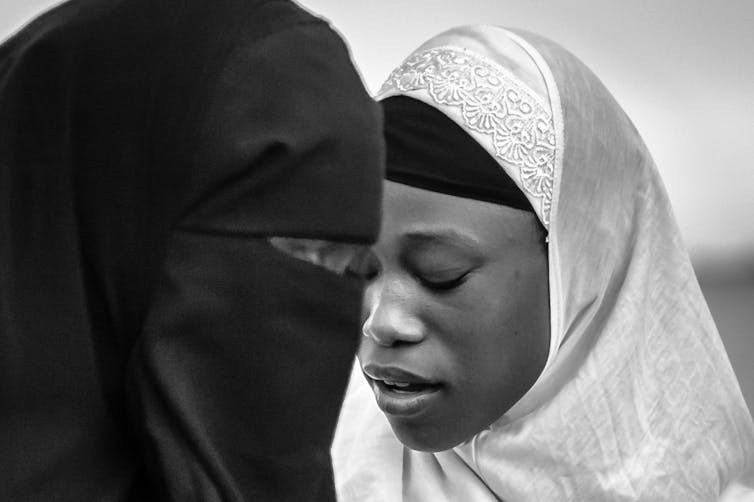
It is obvious that coverings that obscure most of the face, such as the burqa, are likely to be a problem for identification. Merely coverings such equally the headscarf or hijab tend merely to hibernate external features, obscuring face shape, ears and the hair line.
Studies have compared people'south power to match 2 images of a confront when merely internal facial features are shown, such every bit in these images, to when all features are shown.
Results advise that identification accuracy is increased when merely internal features are bachelor - that is, the presence of external features can actually hinder identification. Perhaps we should all wear headscarves to meliorate identification.
The external features of the face, specially pilus line, can exist easily inverse and then may not form a good footing for identification. Importantly, recent research shows that faces shown with a headscarf are rated every bit more similar looking than those without.
This suggests that the headscarf seems to bear upon perceptions of faces even when people are directed to focus merely on the internal features of the face.
Cultural differences in facial recognition
Work by psychologists Ahmed Megreya and Markus Bindemann has also found differences in performance for Westerners (British University students in their studies) and people from Middle Eastern cultures (they looked at Egyptians).
People from cultures where head roofing is mutual really did better at identifying others both with and without the coverings in place.
This effect has been likened to the cantankerous-race effect, where people are better at identifying individuals from their own racial group. Both effects suggest that our perceptions of identity are heavily determined by our experience.
The implications of this research are that we can meliorate our ability to identify others from their face. The hard part is working out how.
Other factors have bigger bear on
The headscarf is one thing, but what about extreme appearance changes caused by ageing, weight loss or gain and plastic surgery?
Historic period-related changes in facial appearance are peculiarly problematic for identification.
Children who are the bailiwick of custody orders or who may be reported as missing can easily go undetected by regime, because the images possessed past government rarely match their appearance.
Despite popular depictions of forensic artists producing accurate "aged" images for identification, there is very little scientific research into the accuracy of these and other forms of epitome-based identification. At the moment, inquiry into the impact of ageing on identification accuracy is a major priority.
On the effect of weight loss or proceeds and plastic surgery, passport officers are trained to pay attention to these factors as potential sources of identification errors. But we have no data to make up one's mind whether or not this grooming is effective.
Refocus from external to internal features
Some researchers have shown that when people focus on internal features during identification tasks they can improve accuracy.
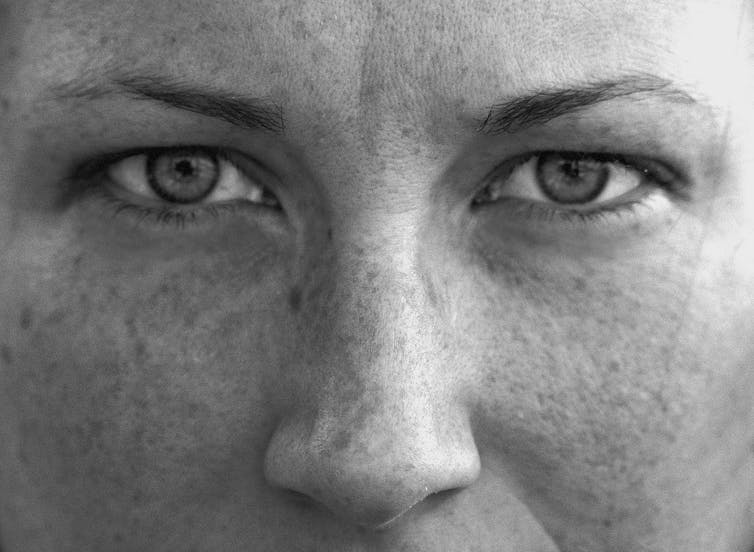
Psychologist Kingsley Fletcher and his colleagues tracked the middle movements of people as they tried to match the identity of unfamiliar faces. They found that focusing on internal features was moderately correlated with identification performance.
But other research has shown that eye movements are highly idiosyncratic and behave no relationship with identification accuracy. To utilize a well-worn statement, more than research is needed.
An even bigger improvement in face-matching accuracy comes from giving people firsthand feedback about their decisions. To make an improvement, this feedback needs to point out when a right decision has been made just also when an wrong decision has been made and what the determination should accept been.
This type of training tin can improve identification accuracy in people with depression aptitude. Only we have merely a unmarried written report that has not been replicated. As nonetheless we don't know how long the improvement lasts.
Given the lack of enquiry, it is certainly not yet time to make recommendations about how nosotros should modify the procedures used by security staff.
Then citing security as a reason for restricting the wearing of head coverings is not entirely supported past psychological enquiry into face up matching. In fact, the data tend to support the reverse conclusion!
But why let a bit of data go far the manner of a political view?
Source: https://theconversation.com/facial-recognition-is-possible-even-if-part-of-the-face-is-covered-32812

Post a Comment for "Facial Recognition to Make Burka Popular Again"